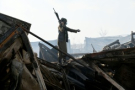
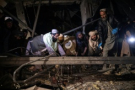
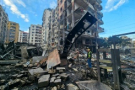
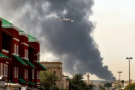
Während die Nacht über Jerusalem Israels geteilter Hauptstadt hereinbricht zieht eine Gruppe israelischer Menschenrechtsaktivisten Bilanz. Den ganzen Tag über haben sie Geld und Sachspenden gesammelt für die bettelarme Beduinenbevölkerung im Süden Israels die ihrer Einschätzung nach besondners hart von den Angriffen der Hamas getroffen wurde. "Wir wollen Solidarität für alle Menschen hier"Noa Dagoni von Human Rights & Democracy erklärt: "Die Bedürfnisse sind enorm. Tausende von Menschen sind in Panik und glauben dass sich niemand um sie kümmert. Sie haben keine Infrastruktur keinen Strom und kein Wasser und keinerlei Schutzunterkünfte. Für uns ist es auch ein Statement dass wir keinen Unterschied zwischen Juden und Arabern machen. Wir wollen Solidarität für alle Menschen hier die jetzt unter diesem schrecklichen Krieg leiden." "Das Einzige was uns aufrecht erhält"Innerhalb kurzer Zeit konnten Hunderte von Hilfspaketen für die Beduinengemeinden zusammengetragen werden. Die Spenden kommen sowohl von Israelis und Palästinensern als auch von ausländerischen Wohltätern sagt Noa Dagoni. "In den letzten zwei Tagen kamen mehr als 100 Menschen um hier freiwillig zu helfen. Und viele viele Menschen haben Geld gespendet. Wir schicken Freiwillige die mit diesem Geld einkaufen gehen und das Gekaufte dann hierher bringen. Es ist wirklich rührend und das Einzige was uns aufrecht erhält. Denn sonst ist es wirklich herzzerreißend." Euroenws-Korrespondetin Valérie Gauriat sagt dass die Spendenakion in den folgenden Tagen fortgeführt wird falls das möglich ist. "Nur eines der vielen Beispiele dafür wie die Menschen versuchen Bedürftigen zu helfen auf welche Weise auch immer."
-
Solidarität im Kriegschaos: Freiwillige sammeln Spenden für Beduinen im Süden Israels
demo
-
Toute l’actualité en VO
4,99€ TTC / moisAccès aux sous-titres,
Je m’abonne
dictionnaire, quiz... -
Uganda election hit by delays after internet blackout
15/01/2026 -
Danish PM says US ambition to take Greenland 'remains intact'
15/01/2026 -
Iran vows to defend itself as Trump says will 'watch it and see'
15/01/2026 -
Fatal back-to-back Thailand crane failures tied to same firm
15/01/2026 -
ISS astronauts splash down on Earth after first-ever medical evacuation
15/01/2026

Solidarität im Kriegschaos: Freiwillige sammeln Spenden für Beduinen im Süden Israels
2023-10-13

Uganda election hit by delays after internet blackout
2026-01-15
Uganda's President Yoweri Museveni admitted even he had problems voting as technical issues disrupted Thursday's election, in which he hopes to extend his 40-year rule, amid an internet blackout and a police crackdown.
Museveni, 81, is widely expected to win a seventh term in office thanks to his total control of the state and security apparatus.
The former bush fighter faces a concerted challenge from singer-turned-politician Bobi Wine, 43, who styles himself the "ghetto president" after his stronghold in the slums of the capital, Kampala.
Wine accused the government of "massive ballot-stuffing" and arresting officials in his party under cover of an internet blackout imposed by the government this week despite repeated promises not to do so.
In many polling stations around the country, voting was delayed by several hours as ballot boxes were slow to arrive and biometric machines -- used to verify voters' identity -- were malfunctioning, which some blamed on the internet blockage.

"Everything they are doing is a sham and it is deliberate," David Lewis Rubongoya, secretary general of the opposition National Unity Platform, told AFP, adding that "no voting" took place in the morning across much of Kampala.
Museveni acknowledged even he had trouble and promised to investigate.
"I put my right... thumbprint. The machine did not accept it. I put my left, it did not accept it," he told journalists, adding that the machine finally accepted a scan of his face, allowing him to vote.
At a polling station on the outskirts of Kampala, voting began four hours late after officials had to switch to manual verification.
"They are trying to steal the poll," said Respy, a woman in her 20s. "They are trying to make us get tired and go home."
- Repression -
There was a heavy security presence in many areas and police have warned the vote is "not a justification for criminal acts", determined to prevent the anti-government protests seen in neighbouring Kenya and Tanzania in recent months.

Journalists have been harassed and Human Rights Watch has denounced the suspension this week of 10 NGOs, including election monitors.
As with his 2021 campaign, hundreds of Wine's supporters have been arrested in the run-up to the vote. He wore a flak jacket at rallies, describing the election as a "war" and Museveni as a "military dictator".
"We are holding elections in the dark," Wine said after casting his vote.
"This is done in order to facilitate the intended rigging of the regime," he said. "We would encourage the people of Uganda to resist."
The government said the internet shutdown was needed to prevent the spread of "misinformation" and "incitement to violence", but the United Nations called it "deeply worrying".

The other major opposition figure, Kizza Besigye, who ran four times against Museveni, was abducted in Kenya in 2024 and brought back to a military court in Uganda for a treason trial that is ongoing.
Many Ugandans still praise Museveni as the man who ended the country's post-independence chaos and oversaw rapid economic growth, even if much was lost to a relentless string of massive corruption scandals.
"Peace and security in the country is very good. The party is well-organised," said Angee Abraham Lincoln, 42, a Museveni supporter waiting to cast his vote in Kampala.
Western countries have often given Museveni leeway after he swallowed their demands for neoliberal reforms in the 1980s and made himself a useful partner in the US-led "war on terror" in the 2000s, especially through troop contributions to Somalia.
The president said his vote, when it was finally cast, was for anyone "who believes in Uganda... who believes in Africa."

Danish PM says US ambition to take Greenland 'remains intact'
2026-01-15
Washington's ambition to take control of Greenland remained intact, Denmark said on Thursday, as a European military mission arrived on the mineral-rich strategic Arctic island, drawing a sharp rebuke from Russia.
The developments came a day after a high-level meeting at the White House failed to resolve "fundamental disagreement" over Greenland, a Danish autonomous territory that President Donald Trump has repeatedly said Washington needs to seize to ensure US security.
The foreign ministers of Denmark and Greenland met with US Vice President JD Vance and Secretary of State Marco Rubio in Washington on Wednesday.
Danish Prime Minister Mette Frederiksen said in a statement Thursday that "a working group" was being set up to discuss how Arctic security could be improved.
"However, this does not change the fact that there is a fundamental disagreement, because the American ambition to take over Greenland remains intact," Frederiksen said.
"This is obviously a serious matter, and we are therefore continuing our efforts to prevent this scenario from becoming a reality," she added.
The head of government's comment came as European military personnel had begun arriving in Greenland.
France, Sweden, Germany and Norway announced Wednesday that they would deploy military personnel as part of a reconnaissance mission to Greenland's capital Nuuk.

"Soldiers of NATO are expected to be more present in Greenland from today and in the coming days. It is expected that there will be more military flights and ships," Greenland's deputy prime minister Mute Egede told a news conference on Wednesday, adding they would be "training".
Germany's defence ministry said Thursday that the reconnaissance mission to Greenland by several European NATO members aims "to explore options for ensuring security in light of Russian and Chinese threats in the Arctic".
"The first French military personnel are already on their way. Others will follow," French President Emmanuel Macron said on X.
Trump has argued that if the United States does not take Greenland, "China or Russia will".
The Russian embassy in Belgium, where NATO is headquartered, said the arrival of NATO forces to Greenland was concerning.
"The situation unfolding in the high latitudes is of serious concern to us," the embassy said in a statement published late Wednesday.
NATO is "building up its military presence there under the false pretext of a growing threat from Moscow and Beijing," the embassy added.
- 'Good relationship' -
After leaving the White House on Wednesday Danish Foreign Minister Lars Lokke Rasmussen said a US takeover of Greenland was "absolutely not necessary."
"We didn't manage to change the American position. It's clear that the president has this wish of conquering over Greenland," Lokke told reporters.
He also noted that "there are no Chinese warships along the coast of Greenland".
"Nor are there any massive Chinese investments in Greenland," he told the Danish press after the meeting.
Trump, speaking after the meeting which he did not attend, for the first time sounded conciliatory on Greenland, acknowledging Denmark's interests even if he again said he was not ruling out any options.
"I have a very good relationship with Denmark, and we'll see how it all works out. I think something will work out," Trump said without explaining further.
He again said Denmark was powerless if Russia or China wanted to occupy Greenland, but added: "There's everything we can do."
- Live 'in peace' -
On the streets of Nuuk, red and white Greenlandic flags flew in shop windows, on apartment balconies, and on cars and buses, in a show of national unity this week.
Some residents described anxiety from finding themselves at the centre of the geopolitical spotlight.
"It's very frightening because it's such a big thing," said Vera Stidsen, 51, a teacher in Nuuk.
"I hope that in the future we can continue to live as we have until now: in peace and without being disturbed," Stidsen told AFP.

Iran vows to defend itself as Trump says will 'watch it and see'
2026-01-15
Iran vowed on Thursday to defend itself against any foreign threat, after US President Donald Trump said he would "watch it and see" about military action over the crackdown on protesters.
Iran's judiciary said a protester who the United States and rights groups feared faced imminent execution would not be sentenced to death, after Trump had warned of strikes should people arrested for demonstrating be killed.
The protests were sparked by economic grievances but evolved rapidly into a nationwide movement that has constituted the greatest threat to the Islamic republic since its inception in 1979.
Rights groups say the crackdown by authorities, who exercise zero tolerance for dissent, has left at least 3,428 people dead. They also accuse the country's theocratic leaders of using an internet blackout to cover up the brutality of their crackdown.
In telephone talks on Thursday, Iranian Foreign Minister Abbas Araghchi told Saudi Arabian counterpart Faisal bin Farhan of the importance of "global condemnation of foreign interference in the internal affairs of regional countries".
The developments came hours ahead of a UN Security Council meeting on Iran later on Thursday, which was requested by the US.
On Wednesday, Saudi Arabia informed Iran it would not allow its airspace or territory to be used to attack it, two sources close to the kingdom's government told AFP.
Up until Wednesday, the United States was threatening military action against Iran should it carry out the death penalty against people arrested over the protests.
In an announcement at the White House, Trump said he had now received assurances from "very important sources on the other side" that executions would not go ahead.
"They've said the killing has stopped and the executions won't take place -- there were supposed to be a lot of executions today and that the executions won't take place -- and we're going to find out," Trump said.

Asked by an AFP reporter in the Oval Office if US military action was now off the table, Trump replied: "We're going to watch it and see what the process is."
The comments sent oil prices plunging on Thursday, as concerns eased of a looming supply shock in energy markets. Iran makes up around three percent of global oil production.
All eyes were on protester Erfan Soltani, 26, in prison in Karaj outside Tehran since his arrest, who is facing charges of propaganda against Iran's Islamic system and acting against national security.
On Thursday, the Iranian judiciary said Soltani has "not been sentenced to death" and if he is convicted, "the punishment, according to the law, will be imprisonment, as the death penalty does not exist for such charges".
- 'No hanging today or tomorrow' -
Iran's judiciary chief had vowed fast-track trials for those arrested, and prosecutors have said some detainees will face capital charges of "waging war against God".
State media reported hundreds of arrests and the detention of a foreign national for espionage, without giving details.
In an interview with US network Fox News, Iranian Foreign Minister Abbas Araghchi said there would be "no hanging today or tomorrow", while accusing US ally Israel of orchestrating violence in Iran, without providing evidence.
Araghchi contends the protests devolved into widespread violence between January 7 and 10 because they were infiltrated by external "elements who had a plan to create a big number of killings in order to provoke President Trump to enter into this conflict and start a new war against Iran".
The authorities imposed an unprecedented internet blackout on January 8, as protests exploded in size and intensity, severely hampering the demonstrators' ability to communicate with each other and the outside world.
Iran's Minister of Justice Amin Hossein Rahimi echoed Araghchi's allegation, telling state news agencies that after January 7, "those weren't protests any longer" and anyone who was arrested on the streets then "was definitely a criminal".
- 'Full control' -
Araghchi said the Iranian government was "in full control" and reported an atmosphere of "calm" after what he called three days of "terrorist operation".
Iran also struck a defiant tone about responding to any US attack, as Washington appeared to draw down staff at a base in Qatar that Tehran targeted in a strike last year.
Iran targeted the Al Udeid base in June in retaliation for US strikes on its nuclear facilities.
Ali Shamkhani, a senior adviser to Supreme Leader Ayatollah Ali Khamenei, warned Trump the strike showed "Iran's will and capability to respond to any attack".
Fears of possible US military action continued to rile the region, and Turkey on Thursday said it opposed a military operation against Iran.
- 'Zero protests' -
G7 nations said Wednesday they were "deeply alarmed at the high level of reported deaths and injuries" and warned of further sanctions if the crackdown continued.
Monitor NetBlocks said Iran's internet blackout had lasted over 156 hours.

Despite the shutdown, new videos, with locations verified by AFP, showed bodies lined up in the Kahrizak morgue south of Tehran, wrapped in black bags as distraught relatives searched for loved ones.
The US-based Institute for the Study of War, which has monitored protest activity amid the shutdown, said it had recorded "zero protests" on Wednesday.
But it added: "The regime is sustaining repressive measures that impose a significant cost on the regime. This suggests that the regime does not perceive that the threat from protests has subsided."
Iran Human Rights, based in Norway, said security forces had killed at least 3,428 protesters and arrested more than 10,000.
burs/sjw-ser/axn

Fatal back-to-back Thailand crane failures tied to same firm
2026-01-15
The collapse of a highway construction crane killed two people near Bangkok on Thursday, with Thailand's leader vowing to blacklist the building firm which was also involved in a crane failure the day before that left 32 dead.
Car dashcam footage verified by AFP showed the moment the massive crane fell on Thursday, unleashing clouds of dust as well as rubble across the area, as several vehicles pulled over or reversed to avoid falling debris.
Motorcycle-taxi driver Booncherd La-orium said he no longer felt safe driving in the area.
"I had goosebumps just thinking about how risky it is to be here. It could have happened to me," the 69-year-old told AFP.
Transport Minister Phiphat Ratchakitprakarn linked firm Italian-Thai Development to the country's second deadly crane collapse in two days, according to local media.
"We have to find out the facts," Phiphat told a local outlet.
Italian-Thai Development was also contracted to build a section of a China-backed high-speed rail project where a huge crane fell on Wednesday, in Nakhon Ratchasima province, derailing a passenger train below and killing 32 of nearly 200 people on board.
In a note to Thailand's stock exchange, Italian-Thai expressed condolences to the victims' of the crane accident on Thursday, saying it would provide compensation.
The firm also pledged to "review and improve safety measures to be more thorough and stringent moving forward", the note said.
Italian-Thai earlier promised compensation to victims of Wednesday's crane collapse and train derailment.
The company -- one of Thailand's biggest construction firms -- has seen several deadly accidents at its sites in recent years.
The crane that fell Thursday at the under-construction Rama II Expressway in Samut Sakhon province, outside Bangkok, left two people dead, a police official told AFP from the scene.
Thai Prime Minister Anutin Charnvirakul told reporters his government would terminate the contracts with the contractor of the two projects where the accidents occurred, without specifying a firm by name.
Anutin said legal action would be taken and the contractor would be blacklisted.
"It has happened three or four times by one contractor. The government is not comfortable letting this kind of company work for the government," he said.
- 'Death Road' -
In other verified footage from the same vehicle as the dashcam, someone is heard saying: "I almost died... Please pull over first".
Another person replies: "That's okay now. It's not falling further."
"That was close," the first person says.

Rescue worker Sutthiwat Thanomsat told AFP he arrived at the scene shortly after the crane crashed down, and witnessed the aftermath of a pickup truck driver killed by the impact.
The Rama II Expressway, a main artery linking the capital to Thailand's south, hosts several major infrastructure projects, including tollway construction.
Construction work has been underway for years to expand the road's capacity and reduce congestion but the project has been beset by delays and fatalities, earning it the nickname "Death Road".
Surachai Wongho, a 61-year-old retiree who drives on Rama II regularly, said he is haunted by the thought that one day he could be hurt in an accident.
"It's the same incident happening over and over again in Thailand. It's time for the government to do something," he told AFP.
In March, a concrete beam forming part of an under-construction elevated roadway collapsed on Rama II, killing several people.
A crane collapse in November 2024 killed at least three workers.
- Silent prayers -
The incident on Thursday followed the crane collapse in Nakhon Ratchasima a day earlier, one of Thailand's deadliest rail accidents in years.

A massive launching gantry crane, used by Italian-Thai in the construction of a high-speed rail project, collapsed onto a passenger train below.
At the site of the deadly accident on Thursday, construction workers milled around the scene, snapping photos of the wreckage, as relatives of victims visited to mourn and pray in silence.
The crane was left hanging off giant concrete pillars, built to hold up the future elevated high-speed rail line -- a joint Thailand-China endeavour.
The nation's rail operator said it ordered Italian-Thai to halt construction until an investigation was completed.
The crane operator was Thai and had fallen and died in Wednesday's accident, an Italian-Thai worker who declined to give her name told AFP.

ISS astronauts splash down on Earth after first-ever medical evacuation
2026-01-15
Four International Space Station crewmembers splashed down in the Pacific Ocean on Thursday, NASA footage showed, after the first ever medical evacuation in the orbital lab's history.
A video feed from NASA showed the capsule carrying American astronauts Mike Fincke and Zena Cardman, Russian cosmonaut Oleg Platonov and Japanese astronaut Kimiya Yui land off the coast of San Diego at 12:41 am (0841 GMT).
"On behalf of SpaceX and NASA, welcome home," mission control told the crew moments after landing.
"It's so good to be home, with deep gratitude to the teams that got us there and back," Cardman replied.
A health issue prompted their mission to be cut short, after spending five months in space.
The US space agency has declined to disclose any details about the health issue but stressed the return was not an emergency situation.
The affected crewmember "is doing fine," NASA Administrator Jared Isaacman told reporters after the splashdown.
Isaacman said only that the crewmember experienced "a serious medical condition" that "could have happened on Earth completely outside of the microgravity environment."
He said all crewmembers are safe, in good spirits and were undergoing standard post-arrival medical checks.
"They just executed... a near-perfect mission on orbit," Isaacman said.
Fincke, the SpaceX Crew-11 pilot, shared a similar message in a social media post earlier this week: "First and foremost, we are all OK. Everyone on board is stable, safe, and well cared for."
"This was a deliberate decision to allow the right medical evaluations to happen on the ground, where the full range of diagnostic capability exists. It's the right call, even if it's a bit bittersweet."
The Crew-11 quartet arrived at the ISS in early August and had been scheduled to stay onboard the space station until they were rotated out in mid-February with the arrival of the next crew.
James Polk, NASA's chief health and medical officer, previously said "lingering risk" and a "lingering question as to what that diagnosis is" led to the decision to bring back the crew earlier than originally scheduled.
- Ready for the unexpected -
The crew conducted a little under 900 hours of experiments during its 167 days in orbit, said Joel Montalbano, deputy associate administrator of NASA's Space Operations Mission Directorate.
American astronaut Chris Williams and Russian cosmonauts Sergey Kud-Sverchkov and Sergei Mikaev, who arrived at the station in November aboard a Russian Soyuz spacecraft, remained on the ISS.
The Russian Roscosmos space agency operates alongside NASA on the outpost, and the two agencies take turns transporting a citizen of the other country to and from the orbiter -- one of the few areas of bilateral cooperation that still endure between the United States and Russia.
Continuously inhabited since 2000, the International Space Station seeks to showcase multinational cooperation, bringing together Europe, Japan, the United States and Russia.
Located some 400 kilometers (248.5 miles) above Earth, the ISS functions as a testbed for research that supports deeper space exploration -- including eventual missions to return humans to the Moon and onward to Mars.
The four astronauts who were evacuated had been trained to handle unexpected medical situations, said Amit Kshatriya, a senior NASA official, praising how they have dealt with the situation.
The ISS is set to be decommissioned after 2030, with its orbit gradually lowered until it breaks up in the atmosphere over a remote part of the Pacific Ocean called Point Nemo, a spacecraft graveyard.

Login


Prev Meaning